
Speech & Language • Digital Wellness
How screen time affects language development
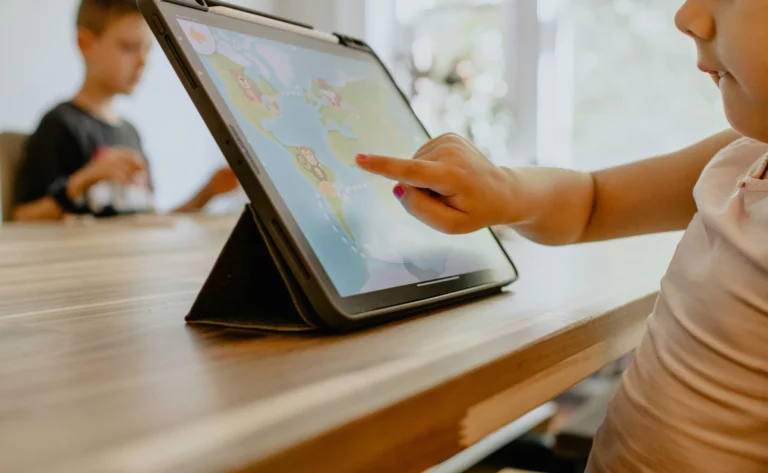
With technology becoming more and more prevalent in our lives, there has also been a rise in screen time. It is important for us, as educators and as parents, to consider how excessive screen time can affect children’s language development.
Many factors have been identified that could affect the link between screen time and language development, which include the amount of communication provided at home, genetics and parent-child interaction. In this article, we will discuss how we can support children’s language development, and explore both the negative and positive effects of screen time on language development in early childhood.
While smartphones, tablets, and TVs can offer valuable educational content, it needs to be in moderation and with mindful selection. We can appreciate that interactive apps and language-learning programs can help children build vocabulary, phonemic awareness, and comprehension skills. However, excessive screen time can hinder language development in several ways. One of the biggest issues we see is the displacement effect, where screen time takes away from real-world interactions and language-rich environments. Children learn best through meaningful interactions with parents and caregivers, and too much screen time can limit these crucial experiences.
Another issue is the passive nature of many screen activities. Watching videos or playing games often involves consuming information rather than actively engaging in conversations or practicing language skills. This passive consumption can impede a child's ability to express themselves verbally and understand nuanced language cues.
Additionally, not all screen content is equal in quality. Exposure to poor-quality language, such as fast-paced cartoons with limited dialogue, might not provide the linguistic stimulation needed for optimal development. We also see that the age of exposure to screen time may result in language delay. In a few studies explored for this article, it was determined that children under the age of 2 should not be watching television.
📱 Remember:
Screens should never act as a babysitter for children. Too often we find caregivers using screen time to distract children rather than provide any educational value. If your child is getting any screen time, it should be intentional and limited.
What can you as parents do to support your child’s language development in today’s highly digital world?
- Set Limits and Establish Screen-Free Zones: Designate times and areas where screens are not allowed, such as during meals or in bedrooms. Prioritise activities that involve meaningful interactions, like reading together or playing games.
- Choose High-Quality Content: “The quality of the programme may affect language development more than the duration of time spent watching the programme” (Karani, Sher and Mophosho, 2022). Therefore, it is important to be selective about what your child watches. Look for educational programs and apps that encourage active engagement and provide meaningful language experiences, rather than cartoons that just act as a distraction for children.
- Engage in Co-Viewing and Co-Playing: Provide commentary, ask questions, and engage in dialogue with your child during screen time. Studies show that children who interact and talk with their parents while they watch any programs tend to have better language skills, further proving that interacting and talking with someone is imperative for children’s language development.
- Balance Screen Time with Real-World Experiences: Make sure your child is still enjoying outdoor play, engaging in social interactions, and participating in hands-on activities that involve various communication opportunities beyond the screen.
- Model Healthy Screen Habits: Children learn by example, so demonstrate healthy media & screen habits yourself.
Screen time does also have some positive effects on a child’s cognitive abilities, higher-order language, and literacy skills, specifically for children above 2 years old. Studies show that sufficient repetitive exposure to a mindfully selected programme improves a child’s problem-solving abilities, ability to imitate and the ability to learn new words (Linebarger & Vaala, 2010).
Q&A from the Speech & Language development discussion held at Geziggies on 25 April with Speech Therapist Tersia de Villiers
Q: My child understands what I say when I talk to him or when I ask him something, but when he communicates back, what he says doesn’t always make sense. How can I help with that? How can I improve his speech?
A: That is called expressive language. You can help by creating a language-rich environment. Start by using simple words and not a lot of language. Also, make sure he is looking at you and registering what you are saying. Acknowledge the things he asks for or says. Another option is to consider sending him for a hearing test. Also, choose one language first and focus on that before introducing other languages.
Q: My wife is Afrikaans, and I’m English. I tend to mix the two languages, so now my daughter also mixes her languages. She understands perfectly, though. When should I start worrying that she’ll develop a problem? How can we prevent it?
A: Associate one language with one person. For example, have her talk Afrikaans to your wife and English to you. Make sure she knows which words and objects are Afrikaans and which are English. You only need to start worrying if her sentence structure gets mixed and doesn’t make sense anymore. Correct sentence structure is important. For example, “Ek het gejump in die pool” or “Ek het ge eet ’n ice cream” indicate a problem.
Q: What is the correct age to start introducing them to technology like phones, tablets, and other small devices (not TV)?
A: Around the age of six. For your child to be ready for primary school, it is more important that they know how to explain, read, count, reason, and summarize. Language is more important in the long run. Technology will come later. Most schools make use of those screens in classes to learn, so they will be introduced to it in time.
Q: I stopped letting my son watch 20-minute episodes/cartoons because I feel it’s better that he watches longer things like movies, etc., where he has to exercise a longer attention span and follow a story for a longer period of time. Is that correct?
A: You’ll have a gut feeling if something is wrong or right. Just be mindful of what they watch. Speak to their teachers as well. They are the ones working with your kids every day and have to compete with what your child watches at home. If once or twice a week they watch a 20-minute episode, it’s okay as long as it’s educational and they learn something.
Q: My son is almost three years old and quite behind on his speech. We started letting him watch Coco Melon, and he can count to ten and say a couple of words that are clear, but some are not clear. He also keeps to himself and in class doesn’t always respond when people talk to him. Is he only starting to develop now? Should I wait and see if it improves, or will I be leaving it too late?
A: If you are really concerned, you can send him for a learning assessment. They will be able to take a look and see if something is wrong and what you could maybe do/change. If what is happening is appropriate for his age, they will tell you to come back in a few months to see if anything has changed. Talk to the teacher as well, but early intervention is definitely best. The broad guideline for speech is as follows: By the age of one, we would like a couple of single words. By the age of two, we would like two to three-word sentences, and by the age of three, sentences of four to five words.
Q: My son has very little interest in educational shows like maths and so on. He will watch for a bit and then wants to watch Paw Patrol or Cars. His speech is still good though; he communicates with me. Should I worry or make him watch less of that?
A: As long as it isn’t too long. Short periods of time are fine. If they watch for too long, they won’t be able to switch off from the screens. They need to play more away from screens. Whether it is outside, with colours, blocks, books, or numbers, that is more important. They need to practice talking, reading, explaining, and thinking. Just keep a good balance.
In conclusion
Exposure to screen time can have both positive and negative effects on children’s language development, however the negatives seem to outweigh the positives. Screen time and carefully selected programs can offer valuable learning opportunities, but intentional and moderate use is important here. Intentional and meaningful interactions with parents/caregivers is more beneficial for children’s language development and should be prioritised, especially in early stages of childhood.
© Early Childhood Development Blog, evidence‑based insights for families & educators
References:
Karani, N.F., Sher, J. and Mophosho, M., 2022. The influence of screen time on children’s language development: A scoping review. South African Journal of Communication Disorders, 69(1), p.825. Published online 2022 Feb 10.
Bhutani, P., Gupta, M., Bajaj, G., Deka, R.C., Satapathy, S.S. and Ray, S.K., 2024. Is the screen time duration affecting children's language development? - A scoping review. Clinical Epidemiology and Global Health, 25, p.101457.
Massaroni, V., Delle Donne, V., Marra, C., Arcangeli, V. and Chieffo, D.P.R., 2023. The relationship between language and technology: How screen time affects language development in early life - A systematic review. Brain Sciences, 14(1).
Blankson, A.N., O’Brien, M., Leerkes, E.M., Calkins, S.D. and Marcovitch, S., 2015. Do hours spent viewing television at ages 3 and 4 predict vocabulary and executive functioning at age 5? Merrill-Palmer Quarterly, 61(2), pp.264-289.


